Article: Different Styles of Necklace Chains: A Guide
Different Styles of Necklace Chains: A Guide
Choosing a necklace chain is about more than matching a shape to your personal style. The construction affects how the piece moves, feels against the skin, supports a pendant, and holds up to everyday wear. It also changes whether the necklace reads as a quiet foundation, a focal point, or one layer in a considered stack.
The different styles of necklace chains each create a distinct balance of flexibility, visual weight, durability, and pendant compatibility. Fine chains can keep a subtle pendant in focus, while thicker or more textured links can carry a larger medallion or stand confidently on their own. The right choice depends on the pendant, how often you plan to wear it, and the look you want to build.
Start by looking closely at the link construction and scale. Comparing those details makes it easier to choose a chain that feels intentional, wears comfortably, and works with the rest of your jewelry.
How to Compare Different Styles of Necklace Chains
Choosing a chain is a practical style decision, not only a question of which link looks attractive. Construction can influence movement, comfort against the skin, wear over time, and whether the chain works best alone or with a pendant. Start by comparing five qualities: link structure, visual scale, movement, expected wear pattern, and the chain's role in the finished look.
Start with construction and visual scale
Look closely at the links before judging the overall silhouette. Are they fine and open, tightly connected, flattened, rounded, or shaped for a more geometric profile? A delicate oval link creates a lighter impression, while a textured or substantial construction can reflect more light and add dimension. These differences also affect how much visual attention the chain commands. Chain choice influences appearance, comfort, durability, and the way a piece fits into everyday wear, so the most eye-catching option is not automatically the most useful one.
Fine chains generally work as a quiet frame for subtle pendants. They can let a gemstone or small charm remain the focal point without adding competing weight at the neckline. A thicker chain makes a different statement: it can better support the visual presence of a substantial medallion or carry the necklace on its own. This is a styling contrast, not a strict rule. Consider the pendant's proportions, the neckline of the clothing you wear most, and whether you want the eye to land on the links or the centerpiece.
Consider movement, comfort, and wear pattern
Next, think about how the chain behaves in motion. A flexible, uniform construction is usually a sensible starting point for a pendant, while a chain chosen for solo wear may be selected primarily for texture or presence. Ask whether the necklace will sit quietly at the collarbone, move as you turn, or be worn alongside other pieces where links can interact. Comfort matters just as much as appearance, particularly if you expect to wear the chain frequently.
Finally, match construction to routine. Occasional, delicate wear calls for careful handling, while a necklace worn repeatedly against clothing or layered with other pieces deserves closer attention to link structure and friction. Compare the chain as part of your real wardrobe rather than in isolation. That approach makes it easier to decide whether the chain should quietly support a pendant, become the focal point, or provide balance between the two.
Classic Link Chains: Cable, Curb, and Box
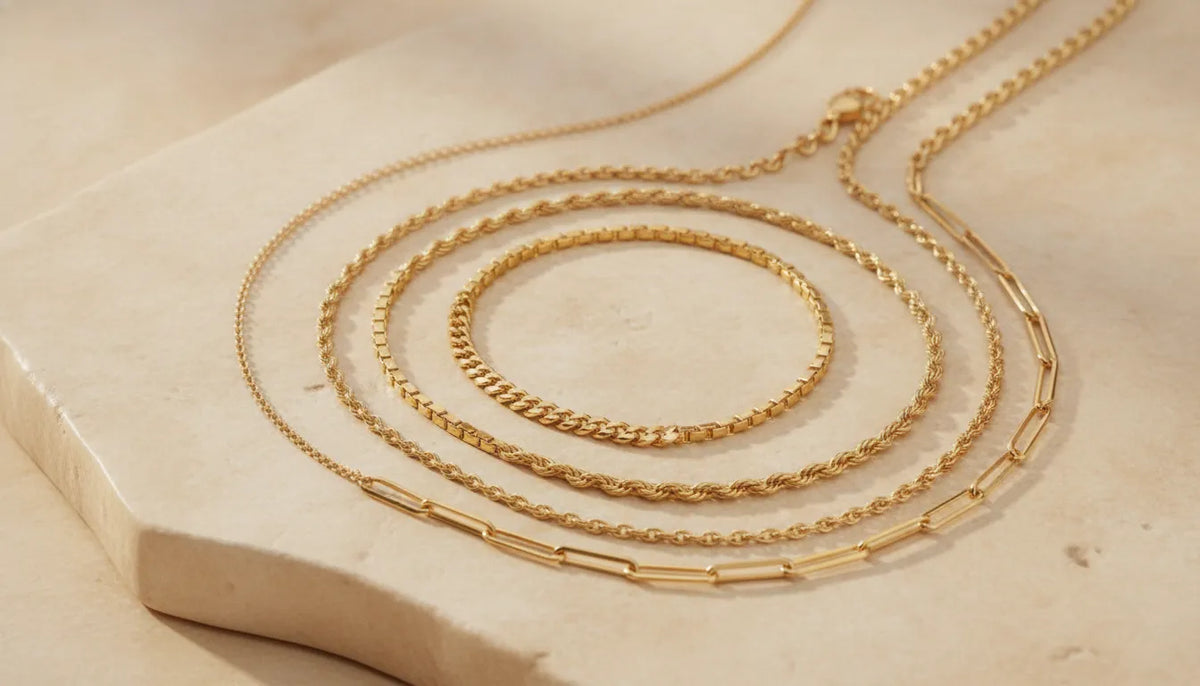
Among the different styles of necklace chains, cable, curb, and box constructions are useful reference points because each creates a distinct balance of movement, texture, and structure. The right choice depends on whether the chain should quietly support a pendant, contribute most of the visual interest, or handle frequent wear with a more substantial feel.
| Chain style | Link construction and look | Pendant use | Care and wear notes |
|---|---|---|---|
| Cable | Uniform round or oval links create a clean, minimal silhouette. | Works with nearly all pendant sizes and many bail shapes. | Its straightforward construction is among the easier chain styles to repair. Check the clasp and links regularly, especially with frequent wear. |
| Curb | Flat, twisted links interlock and lie flush, creating a denser, more grounded profile. | A natural match for heavier pendants or a confident solo look. | Its linked construction is suited to daily wear and is less likely to tangle than finer, more open styles. Store it flat when possible. |
| Box | Square links give the chain a sleek, geometric character. | Well suited to standard-size charms, drop pendants, and classic pendants with smaller bails. | Although sleek and strong, it can kink if bent sharply. Avoid forcing a knot or pulling a bent section straight. |
A cable chain is often the most flexible starting point when the pendant will change over time. Its uniform links keep the chain from competing with the centerpiece, while the range of compatible pendant sizes makes it easy to style across different proportions. For a more chain-led necklace, the flat links of a curb chain add surface and visual weight without relying on a pendant to create interest.
Box chains offer a different kind of restraint. Their square profile reads more architectural than a round-link cable chain, yet it remains polished enough for a classic drop or charm. The care distinction matters: do not sharply fold or twist the chain during storage, travel, or detangling. In every case, match the chain's scale to the pendant's weight and bail. Then consider whether you want the finished look to feel pendant-led, chain-led, or balanced between the two.
Textured and Statement Chains: Rope, Figaro, and Paperclip
Some chains are designed to contribute more than a quiet supporting line. Rope, Figaro, and paperclip constructions bring texture, movement, and visible scale, so the chain itself can become the focal point. A braided or intricately linked surface catches light from multiple angles, while larger links create a stronger sense of dimension than a fine, openwork style. That does not make one construction universally better. The right choice depends on whether you want the chain to frame a pendant or carry the look on its own.
Rope chains: reflective texture with visual presence
Rope chains are formed from links or strands arranged in a twisted pattern. The repeated texture can add perceived volume, which is why the finished diameter matters more than the style name alone. A slim rope chain may support a modest pendant without competing with it, while a wider version can read as a complete necklace when worn solo. Reference guidance describes rope chains as suitable for medium to heavy pendants, but the actual result still depends on the chain's width, construction, clasp, and the pendant's weight. Look at the assembled combination rather than assuming that every rope chain will perform the same way.
Figaro chains: rhythm and a deliberate focal point
Figaro chains are recognized by a repeating pattern of shorter links followed by a longer link. That rhythm creates visual interest even before a pendant is added. A substantial Figaro can anchor a simple neckline on its own, while a finer version can provide texture beneath a small charm or medallion. General chain guidance places Figaro styles with medium to large pendants, though the pendant should be proportionate to the chain rather than merely attached because the bail fits. The repeating pattern may also affect where the pendant or connector rests, so inspect its position and balance from the front.
Paperclip chains: open links and modern scale
Paperclip chains use long, rectangular links to create an open silhouette that feels clean and statement-led. Their spacing lets the chain remain visually legible when worn alone, and a larger version can complement a substantial or graphic pendant. Strength varies with thickness, so avoid treating the open shape as a guarantee of durability. A tightly constructed, appropriately sized chain may be a practical choice for regular wear, but friction, clasp design, and the weight of the pendant still matter. In each case, compare the chain's width with the pendant's scale: a small pendant may disappear against a bold paperclip. While a delicate chain can look visually overwhelmed by a large medallion.
For a custom pendant, the same principle applies. Evaluate the complete piece, including the bail, connector, chain width, and intended wearing pattern. The goal is contrast with control, whether that means a textured chain supporting a quiet pendant or a statement construction worn as the centerpiece.
Which Chain Style Works Best With a Pendant?
The right chain lets a pendant sit naturally, move comfortably, and remain visually balanced. Start with the bail, the small loop that connects the pendant to the chain. Measure its inside clearance, then choose a chain whose clasp or link profile can pass through without forcing the metal. A narrow bail may suit a box chain or fine cable chain, while a larger bail gives you more flexibility with wider or more dimensional links.
Match construction to the pendant's weight
Consider the pendant and chain as one working piece rather than choosing by appearance alone. A flexible, uniform, durable link construction is a practical starting point for pendant wear. Cable chains are especially versatile because their consistent round or oval links can work with nearly all pendant sizes and many bail shapes. A box chain has a clean, geometric profile and can suit a classic drop pendant or a smaller bail. Although it should not be sharply bent because the links can kink.
For a medium or heavier pendant, a chain with more visual and structural presence is usually more convincing than an ultra-fine style. Curb chains have flat, interlocking links that lie close to the body and can complement heavier pendants or frequent wear. Rope and Figaro constructions may also suit medium to larger pendants when their thickness is appropriate. Paperclip chains can complement a statement pendant, but their strength depends on the thickness of the links. So an open silhouette is not by itself a measure of carrying capacity.
Check movement, flexibility, and scale
Think about how the pendant will travel along the chain during a normal day. A fluid chain can help the pendant settle into place, while a highly textured or open chain may become part of the visual statement. Snake chains offer a smooth, flexible finish and can work with light, minimal charms, but their tightly linked construction may tangle and can be more difficult to repair. If the pendant has a broad or angular shape, compare its scale with the chain's width so neither element overwhelms the other.
Length changes the balance, too. A 14- to 16-inch chain generally rests near the collarbone, keeping a small pendant close to the face. A 20-inch or longer chain drapes lower and can give a larger pendant room to move, especially over a high neckline or near a V-neck. For more guidance on choosing a chain for a custom pendant, consider the pendant's bail, weight, intended neckline, and frequency of wear together before settling on a style.
How Length, Metal, and Care Change the Look
Chain length changes where a necklace enters the outfit and how much visual space it occupies. A shorter 14- to 16-inch chain generally rests near the collarbone, making it a natural choice with scoop or crew necklines. It can also keep a small pendant close to the face. A 20-inch chain or longer drapes lower, which can create more separation from the neckline and work well over a high neck or with a V-neck. These are useful starting points, not rigid rules. Your proportions, the chain's width, and the pendant's size all affect the final placement.
Length also helps determine how different styles of necklace chains relate to one another when layered. Two necklaces that sit at nearly the same point can compete, while a deliberate gap lets each surface and pendant read clearly. A shorter, finer chain may provide the quiet first layer, while a longer or more substantial style creates movement below it. Before choosing by measurement alone. Consider where you want the focal point to sit and whether the chain will be worn over bare skin, knitwear, or a higher neckline.
What karat marks tell you
Gold karat marks describe the proportion of pure gold in a piece. The Federal Trade Commission explains that pure 24K gold is soft, so jewelry gold is often mixed with other metals to increase hardness and durability. That is why a lower-karat gold chain is not automatically an inferior choice. The karat, alloy, link construction, width, and intended wear pattern work together to shape how a chain performs and looks over time.
When comparing metals, look beyond the stamp and notice the visual effect as well. A fine chain can keep the overall impression subtle, while a broader or more textured surface reflects more light and becomes part of the outfit on its own. If a chain will carry a pendant, make sure its scale and construction feel proportionate rather than assuming that a particular metal mark guarantees suitability.
Simple storage prevents avoidable tangles
Chains are easiest to care for when they are stored separately, laid flat, and kept away from loose pieces that can catch on their links. For travel or packing, the Gemological Institute of America recommends threading chains through drinking straws to help prevent them from tangling. Fastening the clasp before storage can also keep the chain from forming loose loops. If a knot develops, work slowly on a flat surface rather than pulling, especially with a delicate or tightly linked style.
What Chain Style Is Best for Layering?
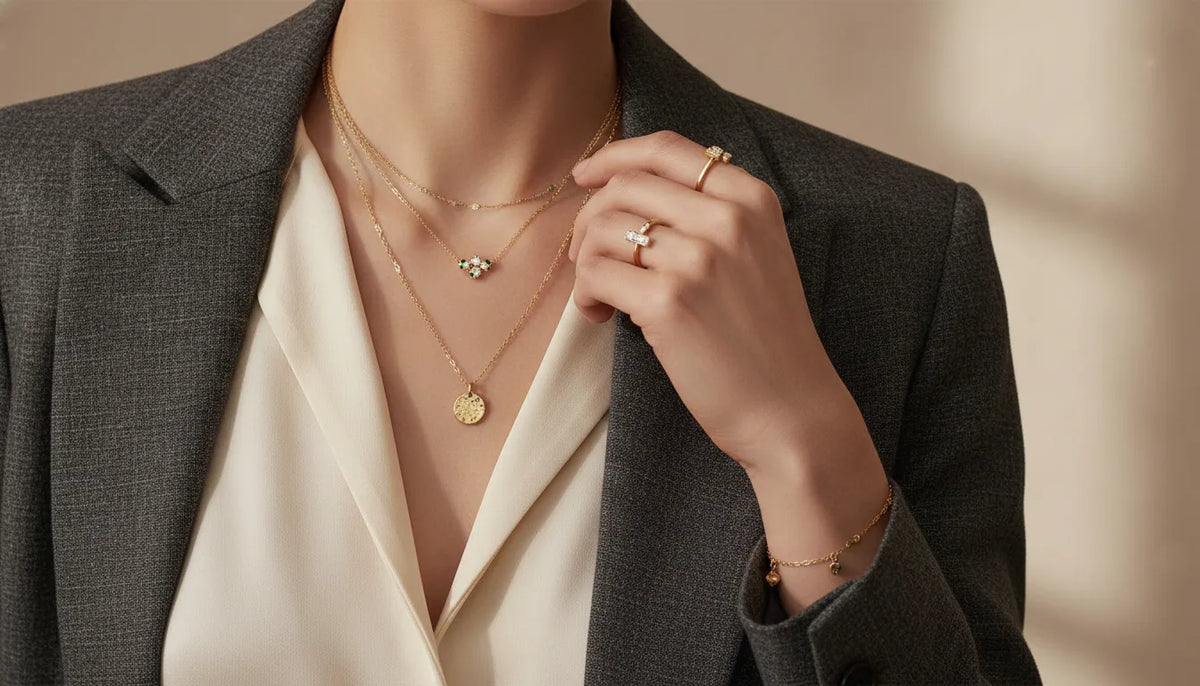
The best layered necklace combination usually comes from contrast, not from matching every detail. Start with one piece that establishes the focal point, then add chains that differ in length, scale, or texture without competing for attention. A short chain can frame the collarbone, while a longer style creates movement below it. Chains around 14 to 16 inches generally sit near the collarbone, and styles 20 inches or longer drape lower. Length is one of the simplest ways to create separation.
Vary length and scale
Build the arrangement from delicate to substantial, or reverse that order when a stronger lower pendant suits your neckline. A fine cable or box chain can provide a quiet first layer, while a thicker curb or paperclip style adds visual weight farther down. The proportions should feel intentional. A small pendant may disappear beside a large link chain, while a substantial charm can overwhelm an especially delicate strand. General chain guidance connects fine chains with subtle pendants and thicker chains with statement pendants or solo wear. Consider both the chain and anything hanging from it. See pairing chain styles with a diamond choker for another example of using a close-fitting silhouette as the starting point.
Mix texture, but keep one focal point
Different styles of necklace chains can work together when their surfaces create distinction. A smooth, fluid chain can balance a textured curb link, while open rectangular links bring a graphic quality to finer strands. You do not need every layer to carry a pendant. Let one necklace provide the focal point and allow the other chains to support it through line, shine, or scale. A lariat can add a vertical drop and shift the eye downward, especially when the other layers sit higher on the chest. For ideas on that silhouette, explore gold lariat chain and pendant styling.
Account for tangling and snagging
Layering is also a practical exercise. Tightly linked or fluid constructions can behave differently as they move, and some snake chains are more prone to tangling and harder to repair. Open links, clasps, and pendants can catch on one another or on clothing, particularly when several necklaces occupy the same space. If you layer daily, test the combination while moving rather than judging it only in a mirror. Store each chain separately when possible. For travel, the Gemological Institute of America recommends threading chains through straws to help prevent tangling: GIA's jewelry travel guidance explains the method.
A Simple Chain-Style Decision Checklist
Use this sequence to narrow the different styles of necklace chains without choosing by name alone. The right chain should suit the way you plan to wear it, the piece it needs to support, and the visual balance you want.
- Start with the purpose. Decide whether the chain is meant to carry a pendant, create a layered look, or stand on its own. A subtle pendant usually benefits from a finer chain, while a substantial medallion may need more visual weight. Chain choice can also affect comfort, durability, and how naturally the piece fits into everyday wear. Learn more about how construction influences wear.
- Check the pendant before the chain. Look at the bail opening, connector, and pendant weight. For pendant wear, a flexible, uniform, durable construction is a practical starting point. Cable chains are broadly versatile, but the chain still needs to pass through the bail comfortably and sit proportionately with the pendant.
- Match construction to frequency. If you expect frequent wear or repeated friction, consider a closely connected construction rather than an especially delicate openwork chain. Box chains can offer a clean geometric profile, but avoid sharply bending them because they may kink. The goal is not to label one style universally best, but to match structure with routine.
- Choose the scale. Compare the chain's actual width, thickness, and visual density with your pendant or neckline. Fine links create a lighter effect. Textured, braided, or larger links bring more dimension and may work well for solo wear. A chain's name does not tell the whole story, so assess the finished proportions.
- Select the length. Chains around 14 to 16 inches generally sit near the collarbone. Styles 20 inches or longer drape lower and can work over high necklines or with V-necks. Consider your usual clothing and whether the chain will be worn alone or layered.
- Consider the metal and karat. Karat marks indicate the proportion of pure gold. Because 24K gold is soft, jewelry gold is commonly alloyed with other metals for greater hardness and durability. Choose a metal and tone that complements your existing collection and intended wear.
- Plan for care. Store chains separately, fasten clasps before putting them away, and keep them from sharp bends. When packing, GIA recommends threading chains through straws to help prevent tangling. For a broader view of curated options, explore fine jewelry necklace styles from LUCE's collection, which includes varied necklace designs without assuming every construction is represented.
Frequently Asked Questions
What are the different types of chains?
Common chain constructions include cable, curb, box, rope, Figaro, snake, paperclip, bead, and wheat chains. They differ in link shape, surface texture, movement, visual weight, and how they connect to pendants. A cable chain uses uniform round or oval links, while a curb chain uses flat, twisted links that lie flush. A box chain has square links and a geometric profile, while a snake chain has tightly linked plates and a smooth finish. Choose by the chain's actual width, weight, flexibility, and intended use rather than the style name alone.
What are 10 different types of necklaces?
Ten useful necklace categories are chain necklaces, pendant necklaces, lariat necklaces, station necklaces, chokers, collar necklaces, bib necklaces, charm necklaces, solitaire necklaces, and layered necklaces. These categories describe the necklace's overall format or styling purpose, while terms such as cable, curb, box, and paperclip describe the chain construction. Length also changes the effect: 14 to 16 inch chains generally sit near the collarbone, while chains 20 inches or longer drape lower. Source: Greenwich Jewelers.
What's the most popular chain style?
Cable chains are a practical, widely useful choice because their uniform links create a clean profile and pair with nearly all pendant sizes. Their simple construction also makes them easy to style alone or layer with more textured pieces. Popularity still depends on the wearer's preferred scale, neckline, pendant, and daily routine.
What are popular chain styles for ladies necklaces?
Popular choices include delicate cable chains for subtle pendants, curb and rope chains for more texture. Paperclip chains for a modern statement, and snake chains for a smooth minimalist look. For layering, combine different lengths and vary the scale so each piece has room to sit separately. If a chain will carry a pendant, check the bail opening, connector, flexibility, and chain weight before choosing by appearance alone.
Ready to Find the Right Chain for Your Collection?
The right necklace chain should suit your pendant, preferred scale, and the way you plan to wear it. For personalized guidance on choosing a chain and styling fine jewelry together, contact LUCE and share what you are looking for.