Article: Types of Earrings Styles: Studs, Hoops, Drops & More
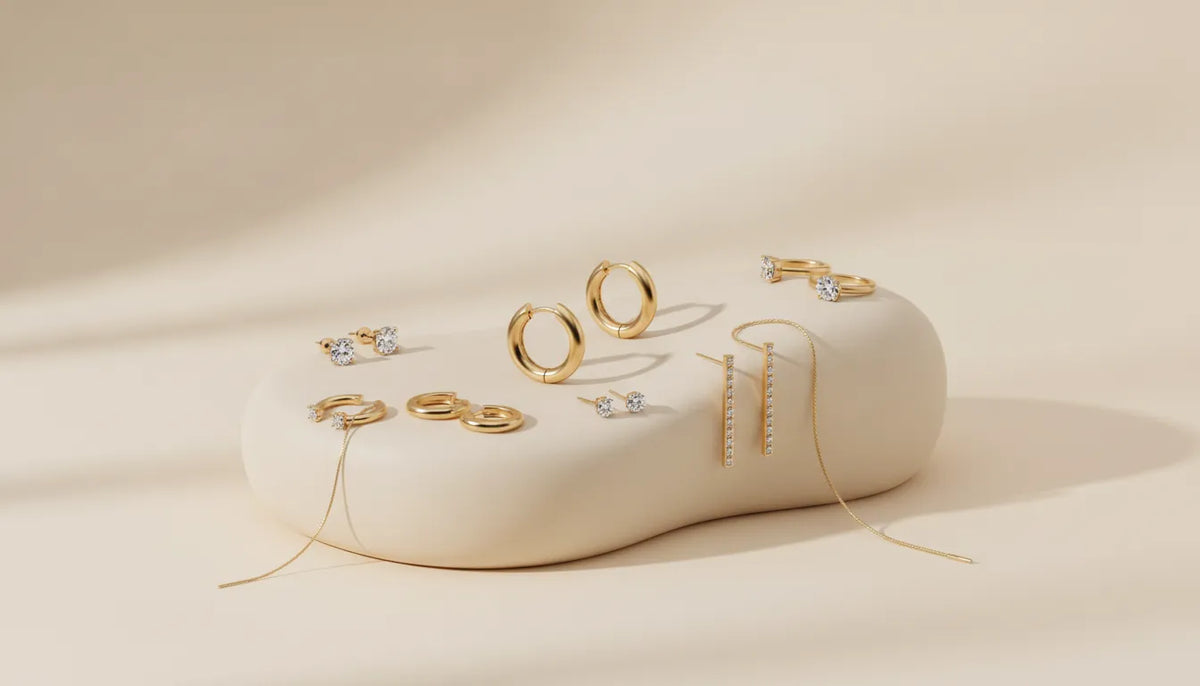
Types of Earrings Styles: Studs, Hoops, Drops & More
An earring can feel understated or expressive before you notice its materials. Shape, distance from the lobe, and movement set the first impression. That makes silhouette a practical starting point when a style name alone is not enough.
Contact LUCE to explore earring styles.
Common earring styles include studs, hoops, close-fitting huggies, drops, and dangles. Threaders, jackets, and ear cuffs offer additional silhouettes. Studs sit at the lobe; hoops form a loop. Drops hang below the ear with little movement, while dangles move more freely. Compare how each sits, moves, and reads at your preferred scale rather than choosing by name alone.
These differences also shape how a pair fits into everyday routines and more dressed-up moments. Start with the core silhouettes, then consider scale and movement together. A close-fitting design creates a different effect from a suspended one, even when both feel equally polished.
What Are the Main Types of Earrings Styles?
Earring styles are easiest to compare by the shape they make on the ear and how they sit or move. A stud stays at the lobe, while a hoop creates a loop; other designs hang below the lobe, trace the ear, or add a frame around another earring. These labels describe overlapping design features, not rigid, mutually exclusive classes. One piece can combine more than one silhouette.
Close to the lobe: studs, hoops, and huggies
Studs sit at the lobe, with their decorative element appearing anchored in place rather than hanging below it. Their outline can be simple or detailed, so "stud" describes placement more than a particular shape. Hoops form a loop, which may read as a slim curve or a more prominent outline depending on the design. Huggies are small, close-fitting hoops that sit near the lobe. They belong to the broader hoop family. Shoppers may treat them as a separate style because their compact profile looks distinct.
Below the lobe: drops, dangles, and chandeliers
Drop earrings hang below a fixed point at the lobe. Their lower element may add length or a focal shape while keeping the overall silhouette relatively still. Dangles also hang below the ear, but their design allows more movement. The terms can overlap in everyday descriptions: a piece might be called a drop for its hanging shape and a dangle for the way its elements move. Chandelier earrings are a more elaborate branch of the hanging family, arranged in branching or layered forms. The names are useful visual shorthand, not a strict technical system.
Lines and frames: threaders, jackets, and cuffs
Threaders use a fine line that passes through the lobe, creating a slender, linear look. Jackets sit behind or around a stud and extend its outline, so the finished effect combines the stud with a framing element. Ear cuffs follow the curve of the ear, bringing attention beyond the lobe. These silhouettes describe where the design appears and the shape it creates. A cuff, for example, may be worn alone or alongside another earring. Details can also combine: a design might pair a stud with a jacket, or bring a hanging element into another silhouette.
Think of the categories as a starting point for describing what catches your eye: a loop, a close-fitting curve, a line, or a shape that hangs and moves. To compare pieces across these silhouettes, explore LUCE earring styles.
Studs and Clusters: Close-Fitting, Low-Profile Styles
A stud sits at the earlobe rather than hanging below it, making it a compact silhouette with little visual movement. That simple outline can still feel distinctive: the stone's shape, the setting around it, and the piece's proportion all influence its look. A single stone reads differently from a group of decorative elements, even when both sit close to the lobe.
One focal point, many possible looks
Studs are not limited to diamonds. Their defining feature is the close-fitting form, while the decorative element can take different shapes and materials. A pear, baguette, or other outline changes the direction and character of the design. A setting can frame that element or leave its silhouette more open. Scale matters, too. A petite stud can be a quiet choice for regular wear. A more prominent design can feel expressive without relying on length or swing. These are options, not rules. What feels right depends on the look you want and how you prefer your earrings to sit.
LUCE's offerings include petite bezel pear studs and baguette studs. For a closer look at one silhouette, see this guide to pear-shaped stud earrings.
Clusters add detail through grouping
"Cluster" describes how decorative elements are grouped, rather than a separate way an earring attaches or a promise about a particular stone. Several elements can gather into one compact focal point, creating a fuller or more intricate impression than a single accent. The overall outline depends on how the elements are arranged and their relative proportions. Some cluster earrings remain close to the lobe; others may extend slightly downward. The label alone does not tell you exactly how much movement to expect.
When comparing these styles, consider the visible shape as a whole. A single stone emphasizes its individual outline, while a cluster creates interest through the relationship between its parts. Either can suit everyday wear or a more expressive look. Start with the profile and scale you enjoy, then check the specific design details rather than assuming every stud or cluster has the same construction.
Hoops and Huggies: From Subtle to Sculptural
A hoop is defined by its loop, but that simple outline can read very differently from one design to another. The curve may be nearly circular or more elongated, open and airy or visually substantial. Look at the whole silhouette, not just the category name. Shape, diameter, thickness, metalwork, and any stones all affect how much space the earring occupies and how strongly it stands out.
How hoop shape and scale change the look
A slimmer hoop with a fine outline tends to feel understated. A wider or more sculpted profile gives the same basic loop more presence. A larger diameter makes the outline more visible around the ear. A compact one keeps the curve closer to the lobe. Neither is automatically better. Consider whether you want the earring to blend into an everyday look or provide a clear, polished accent.
Surface details also change the visual weight. A smooth, open-looking curve leaves more negative space. Textured or dimensional metalwork draws attention to the hoop itself. Stones can add a defined line of sparkle. Their placement matters, too: a detail concentrated at the front creates a different impression from ornament that follows more of the curve. For a closer look at design choices, see this guide to gold hoop earring sizes and styles.
Huggies keep the hoop close to the lobe
Huggies are a close-to-the-lobe subtype of hoop. Their shorter curve creates a compact outline, so the style can feel quiet and neat without losing the defining hoop shape. Yet small does not have to mean visually delicate. A thicker profile, sculptural metalwork, or stones can give a huggie a more noticeable finish while keeping its overall footprint close to the ear.
When comparing options, ask yourself what you want to notice first: the outline, the metal, or the stone detail. A fine, smooth huggie suits a close profile. A more detailed design can bring texture and sparkle to that same compact form. If you are drawn to a stone-set version, explore this guide to pave huggie earrings.
Choose the profile you want to see
For a quieter effect, look for a compact curve and restrained surface detail. For a more visible outline, consider a broader shape, a larger diameter, or a design with stronger metalwork or stones. If you are between the two, compare how much of the ear each silhouette frames and how prominent its details appear from the front. The best choice is the one that feels in balance with your usual styling and the role you want the earrings to play. It might be a subtle finishing touch or a focal point.
Drop, Dangle, and Chandelier Earrings: How They Move
The key difference is not simply how far an earring hangs. Its design also determines how it responds to movement. A drop usually extends below the earlobe from a fixed point. Its silhouette stays comparatively steady. A dangle has a more mobile design that can sway as the wearer moves. These terms can overlap in product descriptions, so look at the construction and the overall outline as well as the label.
Drop earrings: a defined hanging line
A drop design draws the eye below the lobe while keeping its main element in a set position. The result can be a clean, composed line, whether the hanging shape is a single form or a more detailed arrangement. That relative stillness makes drops a useful choice. They offer visible length without making movement the main feature.
For example, LUCE offers an emerald drop design. The name identifies a silhouette, not a promise about how it will feel or suit every occasion. If you are comparing shapes, LUCE's pear drop earring guide explores one version of this hanging profile.
Dangle earrings: movement is part of the look
Dangle earrings include designs that hang from the ear and move more freely. A linked or multi-element outline can create motion that a single, fixed drop does not. The amount of movement depends on the design. "Dangle" alone does not tell you its weight or comfort. LUCE's triple-oval dangle earrings are one example of the category.
Think about whether you enjoy an earring that shifts as you turn your head, or prefer a more settled profile. Either can feel appropriate for everyday plans or a dressier occasion. Personal style, the specific design, and what feels comfortable to you matter more than a fixed occasion rule.
Chandelier earrings: a branching shape, often a dangle
"Chandelier" describes a visual structure rather than a separate movement rule. These earrings typically branch or broaden into multiple tiers, creating an ornamental outline. A chandelier may also be a dangle when its elements hang and move. The categories are not mutually exclusive. The Gemological Institute of America describes a classic chandelier form as three or more drops suspended from one element. This is one example of how the design can build outward from a central point. GIA's overview of classic chandelier earrings offers more on that traditional structure.
This silhouette can occupy more visual space. Consider how much detail you want near the face and what clothing or other jewelry you plan to wear with it. A simpler drop can bring a quieter vertical accent. A branching chandelier makes its layered outline more prominent. Neither is inherently more formal or more comfortable. Choose by the shape you enjoy seeing and wearing, then check the details of the particular pair before deciding.
Threaders, Jackets, Ear Cuffs, and Other Accents
Some earring designs are best understood as accents that change or extend another familiar silhouette. Their names help describe the overall look, but they are not rigid categories. A single pair may combine features of several styles. Thinking about how a design relates to the lobe or ear can be more useful than trying to sort every variation into one fixed taxonomy.
Threaders create a fine, linear look
A threader has a fine line that passes through the lobe, creating a narrow, elongated effect. Depending on the design, the visible line may read as minimal and delicate or bring a little movement to an otherwise simple outfit. Its defining impression is the slender line, rather than a large, fixed shape at the front of the ear. Threaders can feel visually distinct from studs and hoops. They still share the clean simplicity of those styles.
Jackets add a frame to a stud
An earring jacket is designed to sit with a stud, framing it or extending the look below or around it. The stud remains part of the visual composition, while the jacket adds a second layer of shape. That relationship makes jackets a flexible design idea. The result can be subtle with a small accent around the stud. An extension can also make the outline more noticeable. It is less a completely separate silhouette than a way to build on a familiar one. A similar pair can look different depending on the stud chosen. Consider the two elements together rather than judging the jacket alone.
Cuffs and climbers trace the ear
Ear cuffs follow a curve of the ear, with designs varying in how much of that curve they emphasize. Some create a quiet accent; others make the upper ear part of the overall composition. Climbers, also called crawlers, follow the lobe upward, turning the direction of the design into its most noticeable feature. Both can draw the eye beyond the center of the lobe. They create different outlines. A cuff traces an ear curve, while a climber visually travels upward from the lobe.
These styles overlap with the broader earring families rather than replacing them. A jacket may begin with a stud, and an accent that follows the ear can share details with a drop or dangle. Treat the terms as helpful descriptions, not a checklist of mutually exclusive types. If you are comparing the silhouette with how a pair closes, see the separate guide to earring backs for different styles.
How Do You Choose an Earring Style for the Moment?
Start with the impression you want the earrings to make, then consider how they will feel and move during the occasion. There is no single silhouette that works for every person or setting. Your preferences, outfit, and comfort matter more than a fixed styling rule.
| Style | Silhouette and fit | Movement and scale | Decision cue |
|---|---|---|---|
| Studs | Rest close to the lobe, with a contained profile. | Little visual movement; presence depends on the design. | Choose when you want a focused detail that sits close to the ear. |
| Hoops and huggies | Hoops create a loop; huggies are a close-fitting hoop style. | The loop gives a clear outline, from subtle to more noticeable. | Consider them when a curved shape feels right with your outfit. |
| Drops and dangles | Extend below the lobe, with designs ranging from simple to more elaborate. | Drops tend to stay in a defined position; dangles can move more freely. | Choose when you want length or movement to be part of the look. |
| Other accents | Jackets, cuffs, and threaders offer distinct ways to frame or trace the ear. | Their scale and movement depend on the individual design. | Explore these when you want a less familiar silhouette or a layered effect. |
Think about the whole outfit rather than treating the earrings as a separate decision. A close-fitting style may feel at home with a detailed neckline. A more noticeable silhouette can become a focal point alongside simpler clothing. That is a styling choice, not a rule. The same pair can feel different with a different hairstyle, setting, or mood.
Comfort is personal, too. Consider whether you prefer earrings that sit close or ones you notice moving. Also consider whether the weight and feel suit the length of time you plan to wear them. A particular closure is separate from the silhouette. See this guide to earring backs for different styles.
Face-shape styling is another possible lens, not a requirement for choosing a pair. LUCE's separate guide to earring shapes for different face shapes explores that topic. This comparison focuses on the styles themselves. To see the range of silhouettes together, explore LUCE earring styles.
Have a style in mind? Contact LUCE about earring styles.
Frequently Asked Questions
What are the different types of earrings?
Common styles include studs, hoops, huggies, drops, dangles, chandeliers, threaders, jackets, and ear cuffs. Some names describe the overall shape. Others describe how a design sits or moves. A cluster, for example, describes a grouping of elements rather than one fixed silhouette. Hoops form a loop, while a jacket is worn with a stud to frame or extend its look. These categories can overlap in a single design.
What types of earrings are in style?
There is no single style that suits every wardrobe or occasion. Studs and huggies offer a close-fitting look. Hoops, drops, and dangles bring more visible shape or movement. Choose the scale and silhouette you enjoy wearing rather than relying on a changing trend list.
How are drop earrings different from dangle earrings?
A drop earring hangs below the earlobe from a set point and often has little movement. A dangle design is generally made to move more freely. The terms can overlap in product descriptions, so look at the actual construction and how much motion you want.
What is the 2/3 earring rule?
The phrase does not point to a verified, universal standard for choosing earrings. It may refer to different styling advice depending on where you encountered it. If you share the source or context, you can assess what that particular version means instead of treating it as a rule everyone follows.
Ready to Explore Earring Styles?
Choosing between a close-fitting stud, a clean hoop, or a more expressive drop often comes down to the silhouette and movement that feel most like you. A conversation can help you narrow the options around your preferences and the occasions you have in mind. To discuss earring silhouettes and find a style that suits you, contact LUCE about earring styles.